

 Call

 Email

Eye Bolt Anchors: Everything You Need to Know

Managing Director
Lucian Ivan
• 10 minute read

Contents
- What Are Eye Bolt Anchors?
- Types of Eye Bolt Anchors
- How Are Eye Bolt Anchors Installed?
- How to Maintain Eye Bolts and Anchor Systems
- How Often Should Eye Bolts Be Tested?
- What UK Legislation and Standards Apply?
- Need Help with Eye Bolt Installation or Testing?
When it comes to keeping people safe while working at height, the small details matter. One of those details – often hidden in plain sight – is the eye bolt anchor.
Whether installed on a roof or building facade, these safety fixtures provide secure attachment points for fall protection and rope access systems. Used in everything from window cleaning to leak investigations, eye bolts are a common – but often overlooked – element of building safety.
In this guide, we’ll cover all you need to know about eye bolt anchors: what they are, how they’re installed and tested, and how to stay compliant with UK safety regulations.
What Are Eye Bolt Anchors?
Eye bolt anchors are safety devices designed to provide secure connection points for personal fall protection equipment. Typically made of metal, they feature a circular loop – the “eye” – to which safety lines, lanyards or rope systems can be attached using appropriate connectors.

In the context of working at height, eye bolts are classified as anchor devices under BS EN 795:2012. This standard sets out the requirements for anchor systems that form part of a fall protection setup, ensuring they can safely support the force generated during a fall. Eye bolts used in this way must be capable of withstanding dynamic loads and are usually installed into concrete, brick or stone using appropriate fixings or structural anchors.
It’s important to note that not all eye bolts are created equal. Only those designed and certified for fall protection – often referred to as Type A anchor devices or PPE eye bolts – are suitable for use with harnesses and lifelines. These should not be confused with general-purpose eye bolts used for lifting or suspension, which are not tested to the same safety criteria.
When installed and tested correctly, eye bolt anchors enable safe access for a wide range of tasks at height, including window cleaning, facade inspections, roofing work and more.
Types of Eye Bolt Anchors
Eye bolts used for fall protection are generally classified as Type A anchor devices according to BS EN 795:2012. These systems incorporate one or more structural anchors and are designed to provide secure connection points for personal fall protection equipment.
While the physical form of an eyebolt may appear consistent across applications, its suitability depends on how it is installed, tested and certified as part of a complete anchor system.
Below is a summary of some of the high-level applications relevant to eyebolts used in work at height.
Fall Arrest Eye Bolts
Eye bolts installed as part of a fall arrest system are designed to arrest a fall in progress and minimise injury. These anchor systems are typically used with lanyards and harnesses in scenarios where there is a risk of falling from an exposed edge, such as roof work, facade maintenance or plant inspections.
Fall arrest anchor systems can use load-limiting or non-load-limiting Type A designs. Load-limiting versions incorporate elements that absorb energy during a fall to reduce the forces transmitted to the user and structure.
In most cases, a single anchor point is sufficient for fall arrest, provided it meets the minimum static strength requirement of 15 kN (or 21 kN for two users), in accordance with BS 7883:2019.
Rope Access Eye Bolts
For rope access, anchor requirements are stricter. Technicians using rope access methods rely on a two-rope system: one working line and one safety line. As a result, at least two independently secured anchor points are required.
Eye bolts used for rope access must be part of non-load-limiting Type A systems and are typically installed in matched pairs. These systems must demonstrate a minimum static strength of 15 kN per anchor and be positioned to allow safe rigging and effective load distribution. For this reason, system configuration is critical – not just the hardware itself.
All rope access anchor systems must be installed and tested by competent personnel, and undergo testing every six months in accordance with the relevant standards.
Fixed vs. Removable Eye Bolts
Type A anchor devices, including those that use eyebolts, are classified as permanently fixed. However, in some cases, the eyebolt component may be designed to be removable; for example, if it is socket-mounted into a structural anchor that remains in place. This can be useful where aesthetics are a concern or where temporary removal is needed for access or inspection.
It’s important to note that removable eyebolts are not the same as Type B anchor devices, which are fully portable and not fixed to the structure (beam clamps, slings, tripods, etc.). In fall protection, any removable component must still be part of a certified, load-tested Type A system and reinserted correctly in preparation for use.
How Are Eye Bolt Anchors Installed?
Installing eye bolt anchors as part of a certified fall protection or rope access system requires careful planning, the right materials and proven competency, as specified in BS 7883:2019.
Unlike general-purpose fixings, Type A anchor devices incorporating eyebolts are permanent installations that must meet strict safety and performance standards.
Here's a quick overview of how the process works:
Who Installs Them
Eye bolts must be installed by a competent person or company – ideally one approved by the anchor device manufacturer.
The installer is responsible for following a system designer’s specification and must have appropriate training. Importantly, a rope access qualification alone (even IRATA) is not sufficient to carry out installations or testing.
Where They’re Installed
Eyebolts are installed directly into structural materials capable of supporting fall arrest loads. Suitable base materials include:
-
Concrete
-
Brickwork or blockwork (with caution)
-
Natural stone
-
Structural steel
-
Certain roofing systems (where approved)
The structure must be stable, sufficiently thick and free from defects. Installations should avoid weak areas like coping stones or unsupported edges.
How They’re Fixed
Eyebolts are secured using structural anchors – elements that are permanently fixed to the structure. These may be:
-
Resin-bonded (e.g. using a resin socket)
-
Mechanically fixed (e.g. expansion or through-bolts)
-
Welded (by a competent welder to spec)
-
Cast-in during construction
-
Clamped (in rare cases)
Fixings must be compatible with both the eyebolt and the base material. Where fixings are threaded (such as an eyebolt into a socket), correct torque and thread engagement are essential.
What the Installer Must Do
The installer must follow the design specification and manufacturer’s instructions in detail, including hole dimensions, cleaning, embedment depth, orientation, torque settings and more. Positioning matters: the eyebolt should face the direction of expected loading to reduce stress and bending.
Other key considerations include:
-
Trial tests may be needed on-site if the base material’s strength is uncertain.
-
Proof load tests may be performed to verify the installation, especially for hidden or resin-bonded anchors.
-
All works should be documented, including materials used, installation steps, and photographic records for future inspection.
In short, eyebolt installation is a specialist task – it’s not just about drilling and fixing, but ensuring every anchor is correctly positioned, properly tested and fully documented.
How to Maintain Eye Bolts and Anchor Systems
Regular maintenance of eye bolts and anchor systems is essential for ensuring safety when working at height. These components form part of a personal fall protection system (PFPS), and their integrity must be guaranteed through proper inspection, testing and documentation.
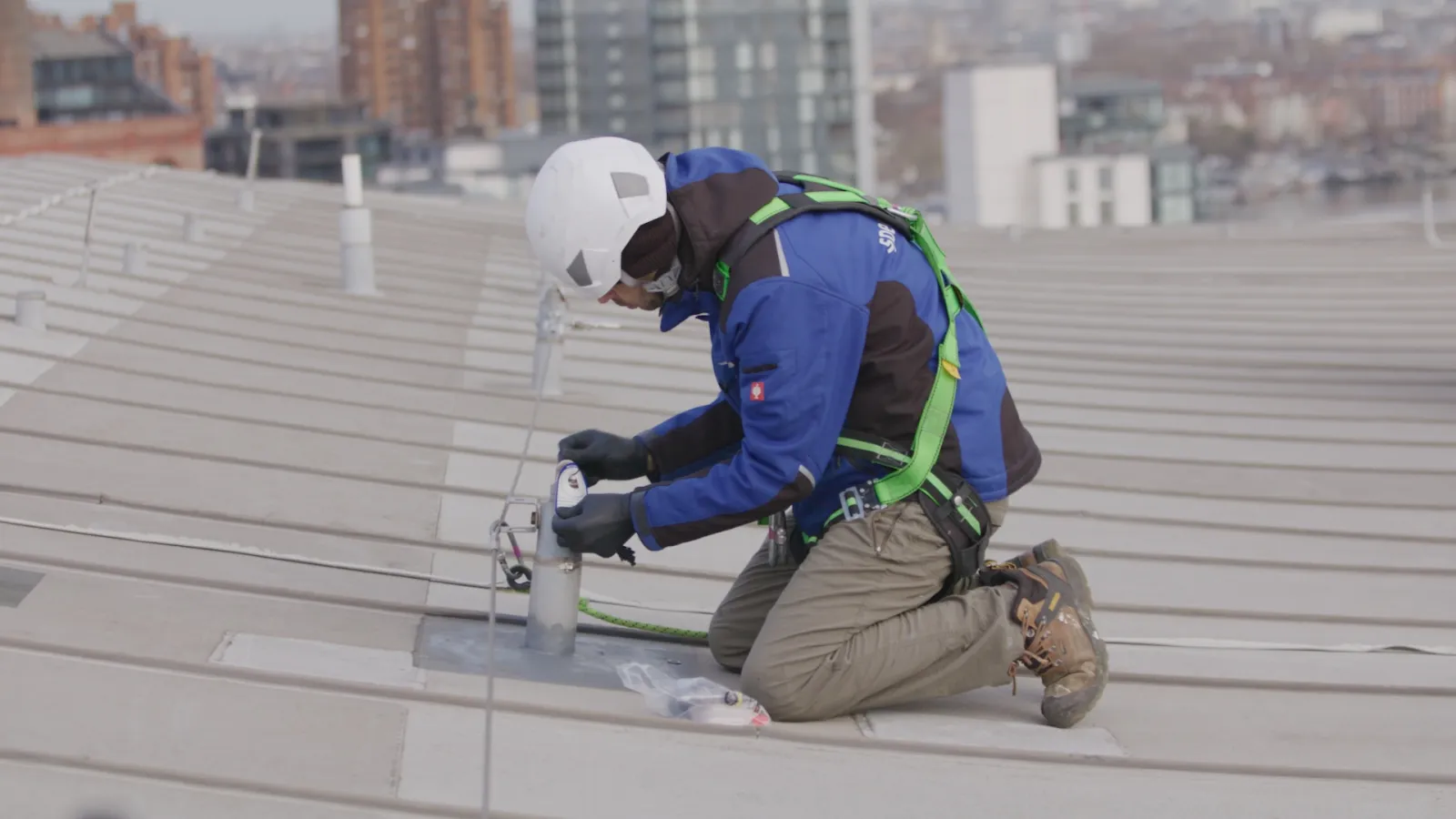
Below are the key steps involved in maintaining these systems:
Adhere to Safety Standards
Maintenance must comply with UK regulations and industry standards, including:
Follow an Inspection Schedule
A defined inspection regime helps identify issues before they become safety risks. At minimum, you should carry out the following:
-
Pre-use inspections: Conducted by the user before each use. These are basic visual and tactile checks for visible damage, wear or signs of corrosion, and to confirm the inspection date is valid.
-
Periodic inspections: Formal inspections carried out by a competent person, typically every 6 or 12 months depending on the system type and usage.
-
Interim inspections: Triggered by unusual circumstances, such as severe weather, a fall or suspected damage.
-
Supplementary inspections: Required to assess hidden elements like structural fixings behind cladding or beneath roofing. These may occur every five or ten years.
-
Inspection prior to first use: Carried out after initial installation to verify the system is safe and correctly installed.
Use Competent Inspectors
Periodic and formal inspections must be carried out by competent individuals – ideally manufacturer-approved – who are experienced, impartial and authorised to withdraw equipment from use if needed.
Carry Out Comprehensive Checks
Each inspection should include:
-
Visual, tactile, and functional checks of anchor devices, fixings, and surrounding structures.
-
Assessment of corrosion, deformation or other deterioration.
-
Review of the surrounding structure to ensure continued suitability.
-
Checks on materials that may have degraded due to weather or chemical exposure.
-
Review of any hidden elements, using records or uncovering parts where necessary.
Conduct Proof Load Testing (Where Required)
For many systems, proof load testing is required during or after installation, and again during periodic inspections. These tests apply a safe, controlled load to confirm that the system can support a real-world fall arrest event.

Maintain Accurate Documentation
The system designer and duty holder must maintain a System Technical File, which includes:
-
Design drawings and layout records
-
Details of structural fixings and materials
-
Installation photos, especially for hidden elements
-
The examination scheme and inspection intervals
-
Operation and Maintenance (O&M) manuals
-
Records of all inspections and tests
Report and Act on Inspection Results
After each formal inspection, a written report must be issued. This will outline the system’s condition, any defects found, recommended actions, and when the next inspection is due.
Inspection outcomes fall into one of four categories:
-
Pass: Safe for continued use.
-
Conditional Pass: Safe to use, but issues must be addressed within a defined timeframe.
-
Conditional Fail: Temporarily withdrawn from use until repaired or retested.
-
Fail: Decommissioned and marked clearly as “DO NOT USE.”
Prompt action should be taken on any failures or defects. Only compatible and approved parts should be used for repairs or replacements.
How Often Should Eye Bolts Be Tested?
For periodic inspections – regular formal checks carried out by a competent person – the required frequency depends on how the anchor is used:
-
At least every 12 months: for fall arrest or restraint systems.
-
At least every 6 months: if the anchor is used for suspension, such as rope access or work positioning.
This is clearly specified in BS 7883:2019 and applies to most permanently installed systems, including Type A eyebolts. If you’re unsure, please get in touch and our team will be happy to advise.
Note that “periodic inspections” are just one form of inspection advised by the standards. For more details on inspection types, please see the “Follow an Inspection Schedule” section above.
What UK Legislation and Standards Apply?
The UK has a broad range of regulations that apply to the installation, maintenance, testing and use of eye bolts for fall protection. We cannot cover everything in this short article (see more regulations here), but you’ll find some of the most important UK and EU standards here:
-
BS 7883: Sets out how anchor systems should be designed, installed, inspected and maintained. Includes inspection intervals and proof load testing requirements.
-
BS EN 795: Defines the safety requirements for anchor devices used in personal fall protection systems. Most eye bolts fall under Type A.
-
BS 8610: Covers testing and marking requirements for structural anchors used in fall protection. Relevant where eye bolts are fixed into masonry, concrete, etc.
-
PD CEN/TS 16415: Provides guidance on anchor systems designed for use by more than one person at a time.
-
The Work at Height Regulations 2005 (WAHR): The main UK legislation for working at height. Requires suitable fall protection systems to be in place and regularly inspected.
-
Lifting Operations and Lifting Equipment Regulations (LOLER): Applies if anchor systems are used for lifting or lowering people, such as in rope access or work positioning.
-
Provision and Use of Work Equipment Regulations (PUWER): Ensures all work equipment, including anchor systems, is properly maintained and fit for purpose.
Need Help with Eye Bolt Installation or Testing?
Anchor system maintenance isn’t just about compliance – it’s about keeping people safe while they work at height. That’s why it’s critical to work with a partner you can trust.
At Spectrum, working at height is what we do every day – from window cleaning to leak detection, we provide building maintenance at height to some of the UK’s tallest and most complex buildings.
We apply our hands-on experience alongside careful application of the standards to inspect, test and maintain fall protection systems across the UK, including eye bolts for fall arrest and rope access.
Whether you need a one-off inspection or ongoing system support, we’re here to help:
-
Get in touch today to speak to a specialist.
Your Building Deserves Thoughtful, Expert Care
Ensure your building remains in top condition with Spectrum Specialist Support. Our expert team offers a full range of exterior maintenance services, from external cleaning and repairs to comprehensive restoration of brick, render, stone and other substrates.
With an IRATA-certified team of abseilers and experience across hundreds of varied projects, we’ll find an access solution that saves you time and money, even on the most complex elevations.
Whether you need emergency maintenance or a tailored service plan, we are here to help. Contact us directly on 020 3551 6206 or email us at info@spectrumss.co.uk to discuss your requirements and receive a free consultation and quote.