Frequently asked questions
Is it a legal requirement to inspect fire doors in the UK?
Yes – fire door inspection and maintenance are legal duties under the Regulatory Reform (Fire Safety) Order 2005 (RRFSO). The Responsible Person – which can be a building owner, employer or property manager – must ensure that all fire doors are kept in efficient working order and good repair.
This legal duty applies to all non-domestic premises (with some rare exclusions) and the common parts of multi-occupied residential buildings, but not typically to single-family homes.
Inspections can be carried out by the Responsible Person if they are competent, meaning they have sufficient training and experience to properly assess and maintain fire doors. In practice, most organisations appoint a qualified fire door inspector to carry out inspections in line with relevant British Standards
Records must be kept, and any defects addressed promptly. Failure to comply can lead to enforcement action, fines or even prosecution, making inspection not just best practice, but a statutory duty.
How often should fire doors be inspected?
In short, it will depend on your building type, use and risk. Under the Regulatory Reform (Fire Safety) Order 2005, all fire doors must be kept in efficient working order, with inspection frequency set by the building’s fire risk assessment.
As a baseline, BS 9999 and BS 8214 recommend inspections at least every six months, with more frequent checks (quarterly or monthly) in high-traffic or higher-risk areas. Many Responsible Persons also carry out weekly visual checks to spot obvious damage.
For multi-occupied residential buildings over 11 metres, the Fire Safety (England) Regulations 2022 also require:
- Quarterly checks of communal fire doors
- Annual checks of all flat entrance doors
All inspections should be recorded, with defects addressed promptly to demonstrate compliance.
Who is responsible for checking fire doors?
By law, the duty lies with the Responsible Person under the Regulatory Reform (Fire Safety) Order 2005. The Responsible Person is typically the building owner, employer, landlord or facilities manager. They must ensure that fire doors are inspected, maintained and kept in efficient working order.
The Responsible Person may carry out checks themselves if they are competent, but in most cases inspections should be conducted by a qualified fire door inspector or competent contractor.
Even if day-to-day tasks are delegated (for example, to a Building Safety Manager), legal accountability always remains with the Responsible Person. They must keep proper records, arrange prompt remedial works, and be able to demonstrate compliance to regulators.
What is involved in a fire door inspection?
A proper fire door inspection is far more than a quick look – it’s a systematic check of every component that ensures the door will perform in an emergency. Each inspection covers the complete doorset, including the leaf, frame, seals, glazing, hardware and signage.
Some of the key checks include:
- Gaps and clearances: typically 2-4mm at the head and sides; thresholds within tolerance, with tighter limits where smoke control is required.
- Seals: intumescent and smoke seals present, intact and not painted over.
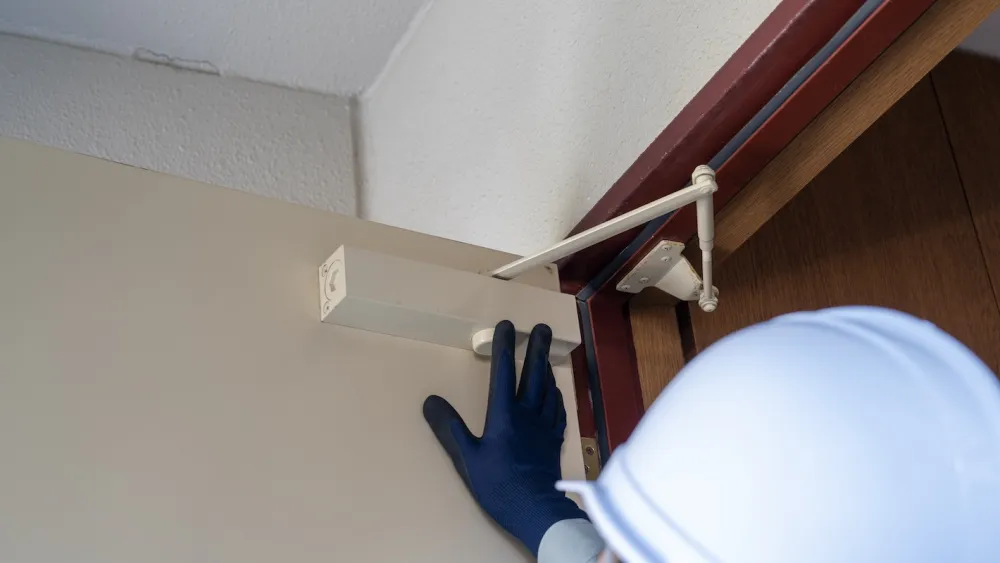
- Closers: door closes fully and smoothly, never wedged open.
- Certification labels: clear, intact and correctly positioned.
- Hardware: hinges, locks, latches and handles working and certified for use with door leaf.
- Signage: mandatory fire door signs (e.g. "Fire door keep shut", "Automatic fire door keep clear") must be fitted correctly, visible and legible on both sides.
- Damage: no cracks, warping, missing beading or structural faults.
- Glazing: fire-rated glass intact and securely installed.
Each door is inspected individually, with findings fully documented and remedial action recommended where needed.
How long does an inspection take?
A fire door inspection typically takes 10-20 minutes per door for a full compliance check. The exact time depends on the door’s design, condition and location within the building.
As a guide:
- Standard doors in smaller properties: around 10 minutes each.
- Doors in large or complex buildings: closer to 20 minutes each, especially where multiple safety components need checking.
- High-traffic or specialist settings: inspections may take longer due to higher wear, detailed reporting, or integrated fire safety systems.
For larger sites with many fire doors, full inspections can take several hours or even multiple days. Before work begins, our team will provide a time estimate based on your site survey and total door count.
How do I know if my fire doors are compliant?
Compliance is more than fitting a fire-rated door – the whole doorset (leaf, frame, glazing, seals and hardware) must meet legal and technical standards, be in good condition, and have proper records in place.
A compliant fire door will have:
- Certification evidence: A visible manufacturer label, UKCA/CE mark or plug showing its fire rating (e.g. FD30). These markings must be intact and legible. Third-party certification (e.g. BM TRADA Q-Mark) provides added assurance.
- Correct components: Consistent gaps (typically 3mm at the sides and head, with tighter thresholds where smoke control is required), intact intumescent/smoke seals, a functional self-closing device, and certified hinges, locks and handles with intumescent protection where specified.
- Good condition: No cracks, warping, missing beading, loose glazing or unauthorised alterations that could reduce performance.
- Mandatory signage: Clear and correctly positioned “Fire door keep shut”, “Keep locked” or “Automatic fire door keep clear” signs, depending on the door type.
- Inspection records: Documented checks, defects and remedial works logged in line with the Regulatory Reform (Fire Safety) Order 2005 and other relevant legislation
Regular inspections by a competent, accredited inspector confirm that these requirements are met. If labels are missing, components are damaged, or inspection records are incomplete, the door cannot be considered compliant.
What happens if a fire door fails an inspection?
If a fire door fails inspection, defects are graded by severity and the required next steps:
- Minor faults: Small issues like loose hinges, seal damage or closer adjustments can usually be repaired quickly.
- Moderate faults: Defects affecting performance, such as missing intumescent strips or excessive gaps, often need more extensive remedial work.
- Major faults: Serious damage, warped doors, missing components or compromised frames usually mean the door or doorset must be replaced.
Most fire door defects can be repaired by qualified specialists, but where fire resistance or structural integrity is compromised, replacement is the only safe option.
If defects are not addressed, the Responsible Person risks enforcement action under fire safety law. This can include enforcement or prohibition notices, heavy fines, invalidated insurance, or even prosecution. In serious cases, a building can be closed until compliance is restored.
The bottom line: many faults can be repaired, but timely remedial action – or replacement where necessary – is essential to maintain both safety and compliance.
What maintenance do fire doors need?
Fire doors are only effective if they are properly maintained. The Regulatory Reform (Fire Safety) Order 2005 makes it a legal duty to keep them in efficient working order, with maintenance tailored to the building’s use and risk level.
Key maintenance activities include:
- Routine inspections: Typically at least every six months, with quarterly or monthly checks in high-traffic or higher-risk settings, plus annual flat entrance door checks in taller residential blocks.
- Repairs: Fix or replace damaged seals, closers, hinges, locks and handles using certified, compatible components only, in line with the door’s original test evidence.
- Avoid overpainting: Intumescent-only seals may tolerate light overpainting, but combined smoke seals must never be painted over. In all cases, excessive paint layers will impair performance.
- Closer testing: Regularly test self-closing devices to confirm they shut doors fully and reliably.
- Documentation: Keep inspection logs, defect reports and records of repairs or replacements as evidence of compliance.
Proper ongoing servicing by competent, trained personnel ensures fire doors remain compliant and capable of protecting lives and property.
How long do fire doors last?
With proper care, fire doors can last 10-30 years. Their actual lifespan depends on traffic levels, environment, installation quality and how well they are maintained.
As a guide:
- Typical lifespan: 10-20 years with routine inspections and maintenance.
- Longer lifespan: Up to 30 years in low-traffic, stable environments with careful use.
- Shorter lifespan: High-traffic areas or harsh conditions can reduce durability significantly.
Factors that influence longevity include:
- Traffic and usage
- Environment – moisture, temperature changes or impact damage can cause warping and seal failure
- Installation quality
- Maintenance
- Compliance – fire doors must remain capable of performing to their FD30, FD60 or other rating, demonstrated by inspection records.
The bottom line: a fire door’s lifespan isn’t fixed. Ongoing inspections and timely maintenance can add many years of reliable service, while neglect may cut its life short.
Our BM TRADA-certified team provides both inspections and maintenance, helping extend the life of your fire doors while keeping them safe and fully compliant.
How much does a fire door inspection cost?
Costs vary depending on your building’s size, location and the number of doors. As a rough guide:
- Per door: Around £20-£100 per door, with lower rates on bulk inspections.
- Small sites or single doors: Fixed-price surveys typically start from £250 + VAT.
- Large sites: Pricing is quoted per site, with additional charges if multiple visits or specialist reporting are needed.
The inspection report typically includes:
- Full condition check of each fire door and its components.
- Compliance evaluation against relevant standards (e.g. BS 8214, BS 9999) and manufacturer’s certification.
- Photographic evidence of defects and a complete inventory of doors inspected.
- Recommendations for remedial works or replacements.
Follow-up works are usually quoted separately. Minor issues can often be repaired quickly, while larger remedial projects or replacements are planned afterwards.
A fire door inspection is a cost-effective compliance investment. Pricing scales with site size, but every report provides clear evidence to help Responsible Persons meet legal duties and maintain safe escape routes.
What certification or report will I receive after an inspection?
After a fire door inspection, you’ll receive a detailed compliance report – a critical document for fire safety management, audits and regulatory evidence.
Your report typically includes:
- Door-by-door schedule: Unique identifiers, locations, door types and fire ratings (e.g. FD30, FD60).
- Photographic evidence: Images of each door, highlighting defects or compliance markings.
- Defect log: Clear descriptions of issues such as damaged seals, faulty closers or missing signage.
- Compliance status: Assessment of whether each door passes or requires remedial action.
- Corrective actions: Practical recommendations for repairs, adjustments or replacements.
- Inspector details: Date, inspector’s name and qualifications (e.g. BM TRADA, FDIS).
- Signed compliance statement: Confirmation that the inspection was carried out in line with relevant fire safety legislation and British Standards.
This report is more than paperwork – it provides legally recognised evidence of compliance under relevant legislation. It supports audits, validates insurance claims and demonstrates that the Responsible Person has taken all necessary steps to keep fire doors safe, compliant and fit for purpose.


 Call
Call
 Email
Email