Frequently asked questions
Are fire doors a legal requirement in the UK?
Yes, in most commercial, multi-storey and multi-occupancy buildings, fire doors are legally required.
In the UK, building owners, landlords, and duty holders are legally required to install and maintain certified fire doors under the Regulatory Reform (Fire Safety) Order 2005. These laws apply to non-domestic buildings, Houses in Multiple Occupation (HMOs) and flats, where doors lead onto escape routes like stairwells and communal corridors.
The Fire Safety Regulations 2022 introduced additional responsibilities for multi-occupied residential buildings that are over 11 metres in height, including routine fire door checks.
The bottom line? If you manage a rental, commercial, or residential block, fire door compliance isn’t just best practice, it’s the law.
What’s included as standard?
A standard fire door installation includes everything required for full compliance and performance, not just the door itself.
As standard, your new fire door will be fitted with:
- Intumescent strips and smoke seals to block fire and smoke.
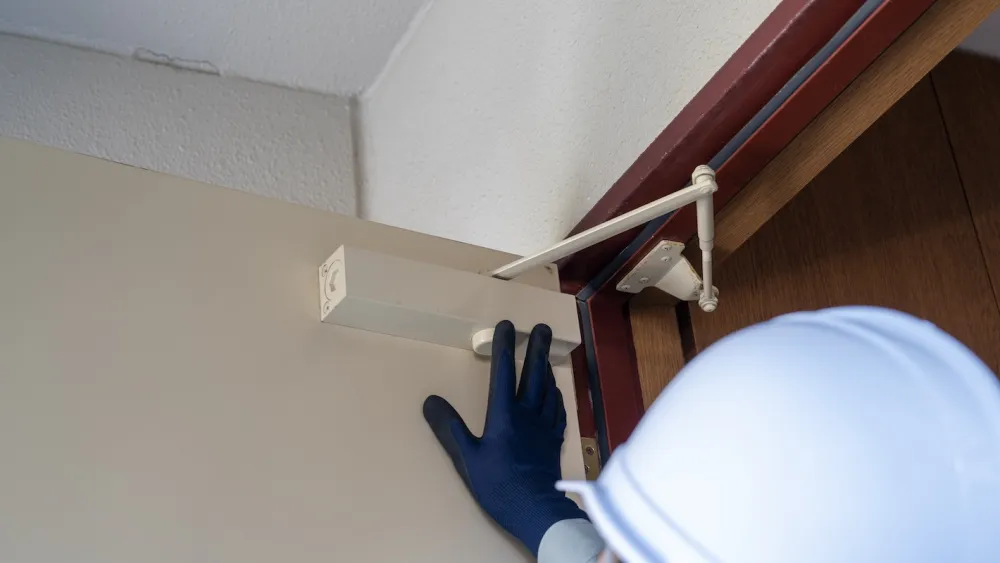
- Self-closing device to ensure the door always shuts securely.
- Fire-rated hinges, locks, and handles, tested to withstand heat.
- Certified door frame, installed with fire-stopping materials and minimal gaps.
- Mandatory signage (e.g. “Fire door keep shut”).
If needed, we also fit fire-rated glazing, intumescent letterboxes, and acoustic or smoke seals.
Every component is installed to the manufacturer’s specification and certified to BS EN 1634, so you can be confident your door is legally compliant and built to perform.
How long does it take to install a fire door?
A typical fire door installation takes between 1-3 hours per door, depending on the type of door and the condition of the opening.
- Pre-hung or straightforward timber doors can often be installed in 1-2 hours.
- Bespoke or steel doors may take 3-4 hours due to additional fittings.
- Replacement jobs that involve removing old doors and adjusting frames can take longer.
On a well-prepared site, our team can usually install 3-5 doors per day. For larger or more complex projects, installation rates may be lower to allow for access planning, hardware adjustments and compliance checks.
Every installation is completed to full UK regulations, including gap tolerances, hardware fitting and certification, so you can be confident it’s done right, not just quickly.
What rating do I need – FD30 or FD60?
The numbers in FD30 and FD60 refer to the minutes of protection the fire door offers in a fire. For example, an FD60 door will have been proven to resist fire and smoke for at least 60 minutes when installed correctly.
FD30 doors are the most common and provide 30 minutes of protection. They’re usually required for escape routes in standard residential and smaller commercial buildings.
FD60 doors provide 60 minutes of protection and are specified where evacuation may take longer or the fire risk is higher, such as stairwells, basements, hospitals or care homes.
A fire risk assessment will confirm the correct rating for each door, taking into account your building’s size, layout and occupancy.
In short: FD30 is the most common legal minimum in most settings, while FD60 is required in higher-risk or complex environments.
How much does a fire door installation cost?
The cost of a fire door installation in the UK typically ranges from £400-£1,300 per door, depending on the specification and site conditions.
- A standard FD30 timber door (supply and fit) is usually £400-£600.
- Glazed or bespoke designs may cost £700-£1,000.
- FD60 or specialist doors can range from £650-£1,300+.
- Commercial steel doors may exceed £1,500 due to size and complexity.
The final price depends on factors like the fire rating required, whether the door is bespoke or pre-hung, the hardware specified and how much preparation is needed on site.
We always carry out a survey and compliance check before quoting, so you know the price covers everything, from certified doors and hardware to professional installation and disposal of old doors.
Do occupants/tenants/residents need to vacate during installation?
In most cases, no – residents or tenants don’t need to leave the building while fire doors are being installed. Work is carried out one door at a time, so disruption is kept to the immediate area.
For safety, we may ask occupants to avoid the doorway being worked on until the installation is complete. In multi-occupancy buildings, we coordinate closely with residents to keep access routes clear and safe.
If doors on key escape routes are being replaced, we will put temporary measures in place, such as alternative access points, to ensure the building always remains compliant during the works.
What’s the difference between a fire door and a standard door?
Unlike a standard door, it is specially designed, tested and certified to resist fire and smoke for a set period of time, usually 30 or 60 minutes.
Key differences include:
- Fire resistance: Fire doors carry a rating such as FD30 (30 minutes) or FD60 (60 minutes), while standard doors offer no tested protection.
- Construction: Fire doors have solid, fire-resistant cores with intumescent strips that expand under heat to seal gaps.
- Safety features: They are fitted with fire-rated hinges, locks, handles and a self-closing device to ensure they shut automatically in a fire.
- Certification: Every fire door is labelled to prove compliance with strict UK and European standards.
In short, a fire door is a piece of certified safety equipment designed to slow fire and protect escape routes, whereas a standard door is not.
What does intumescent mean?
“Intumescent” refers to a material that swells dramatically when exposed to high heat. Through a chemical reaction, it expands many times its original size to form a charred, insulating layer.
In a fire, this expansion seals gaps around doors, frames, or glazing, helping to block flames, heat, and smoke from spreading.
The most common examples in fire door installation are intumescent strips and smoke seals, which stay discreet in normal use but activate in an emergency to maintain the door’s fire rating.
How can I tell if my fire door is compliant?
A compliant fire door is part of a certified system, not just the door leaf itself.
Here’s what to look for:
- Certification label: Check the top or edge of the door for a manufacturer’s label showing the fire rating (FD30, FD60) and test details.
- Correct components: A true fire door set includes the matching certified frame, intumescent strips, smoke seals, self-closing device and fire-rated hardware.
- Good condition: Gaps should be tight (usually no more than 4mm), seals intact, and no unauthorised modifications or damage.
- Documentation and inspection: Installation should follow the manufacturer’s instructions, and compliance requires regular inspection by a competent, accredited company.
If you’re unsure, our BM TRADA-accredited team can carry out professional fire door inspections. We’ll confirm whether your doors meet current UK standards and provide full documentation for your compliance records.
How long do fire doors last?
Fire doors don’t have a set expiry date. With proper installation, regular inspections, and good maintenance, they can often last 20 to 30 years.
Their lifespan depends on several factors:
- High-traffic doors will wear faster than rarely used ones.
- Regular checks and timely repairs are essential to keep them compliant.
- Moisture, impact damage or harsh conditions can shorten service life.
- Regulations may change, requiring doors to be upgraded even if they look sound.
Fire doors should be inspected at least every six months, or more often in heavy-use areas. Our accredited team can carry out professional inspections, identify issues like worn seals or oversized gaps, and confirm whether your fire doors remain compliant.


 Call
Call
 Email
Email