

 Call
Call
 Email
Email
What Is a Section 20 Notice for Major Works?

Managing Director
Lucian Ivan
• 12 minute read

Contents
- What Is a Section 20 Notice?
- When Is a Section 20 Notice Required?
- Who Has to Comply with Section 20 Requirements?
- How Does the Section 20 Consultation Process Work?
- How Long Does Section 20 Consultation Take?
- What Happens if Section 20 Consultation Is Not Followed?
- Can Leaseholders Refuse to Pay for Major Works?
- Best Practices for Managing Section 20 Major Works
- Planning Major Works? We Can Help Minimise Disruption
Major works on leasehold properties can quickly become complicated, especially when legal consultation requirements come into play.
If you’re planning significant repairs or refurbishment works, a strong understanding of the Section 20 consultation process is essential. Failing to follow the correct procedure can lead to disputes with leaseholders and restrictions on recovering costs.
In this guide, we’ll explain what a Section 20 notice is, when it’s required and how the consultation process works in practice.
What Is a Section 20 Notice?
A Section 20 notice (S20) is a formal legal notice that landlords, freeholders and managing agents must issue before carrying out certain works or entering into long-term service agreements on leasehold properties.
The notice forms part of the Section 20 consultation process under the Landlord and Tenant Act 1985. Its purpose is to ensure that leaseholders are properly consulted before they are asked to contribute towards significant costs through the service charge.
The consultation process gives leaseholders – and any Recognised Tenants’ Association (RTA) – the opportunity to review proposed works, raise observations and, in some cases, nominate contractors during the tendering process.
Although Section 20 consultation is designed to protect leaseholders, it also protects landlords and managing agents by providing a clear legal framework for recovering costs and delivering large-scale maintenance projects correctly.
When Is a Section 20 Notice Required?
A Section 20 notice is usually required when proposed works or services will result in leaseholders paying more than a set amount through the service charge.
Under the Landlord and Tenant Act 1985, consultation requirements apply in two main situations:
-
Qualifying works where any individual leaseholder will pay more than £250.
-
Qualifying long-term agreements where any individual leaseholder will pay more than £100 per year.
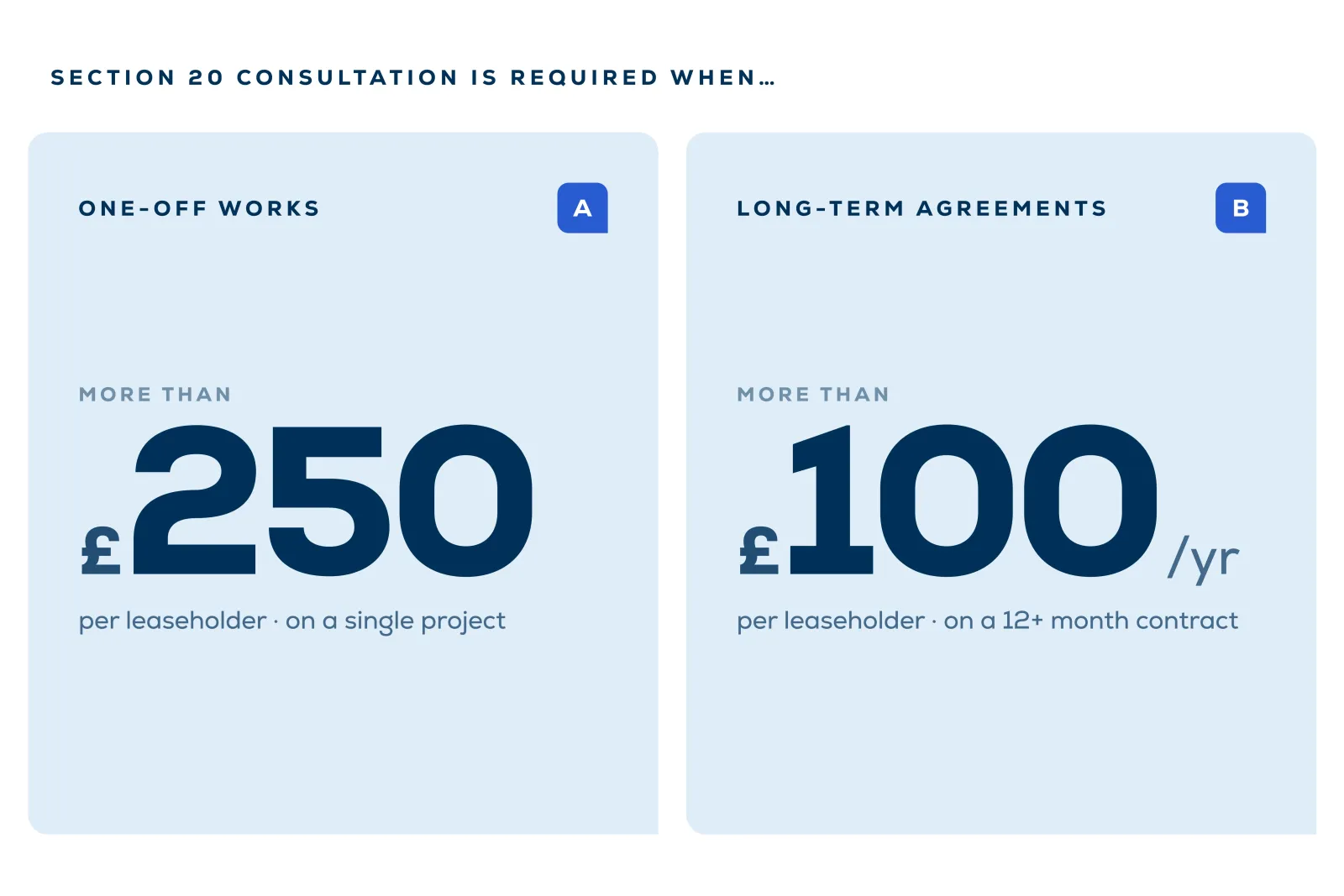
Although the phrase “major works” is widely used across the property sector, the legislation itself refers to “qualifying works”. In practice, this generally means repair, maintenance or refurbishment works that exceed the statutory cost threshold.
Common examples of works that may require Section 20 consultation include:
-
Roof repairs or replacements
-
External redecoration
-
Structural repairs
-
Window replacement programmes
-
Lift refurbishments
-
Concrete repairs
The rules can also apply to ongoing contracts for services such as cleaning, grounds maintenance or mechanical servicing where costs exceed the annual threshold.
When estimating whether the threshold is likely to be exceeded, VAT and associated consultant costs should be considered, although recent case law has clarified that professional services are not themselves qualifying works.
In most cases, the responsibility for complying with Section 20 requirements falls to the landlord, freeholder or managing agent responsible for recovering costs through the service charge.
Who Has to Comply with Section 20 Requirements?
The responsibility for Section 20 consultation usually sits with the landlord or freeholder, as they are the party seeking to recover the cost of works or services through the service charge.
In practice, the process may be handled by a managing agent, property manager, housing association, resident management company or right-to-manage company, depending on the lease structure and management arrangements.
However, the key point is that the consultation must be carried out by the party responsible for arranging the works or agreement and recovering the relevant costs.
This distinction can matter where there are several parties involved in a building’s management. For example, there may be a superior landlord, an intermediate landlord and individual leaseholders. In those cases, responsibility will usually fall on the party seeking to recover the relevant costs through the service charge.
For managing agents and property managers, this means the safest approach is to confirm responsibility at the outset. Before works are scoped, tendered or instructed, it should be clear who is issuing notices, who is responding to leaseholder observations and who will ultimately seek to recover the costs through the service charge.
How Does the Section 20 Consultation Process Work?
The Section 20 consultation process is designed to give leaseholders advance notice of proposed works or agreements before significant costs are recovered through the service charge.
For qualifying works, the consultation process is usually divided into three stages. Each stage has specific notice requirements and minimum consultation periods that landlords or managing agents must follow.
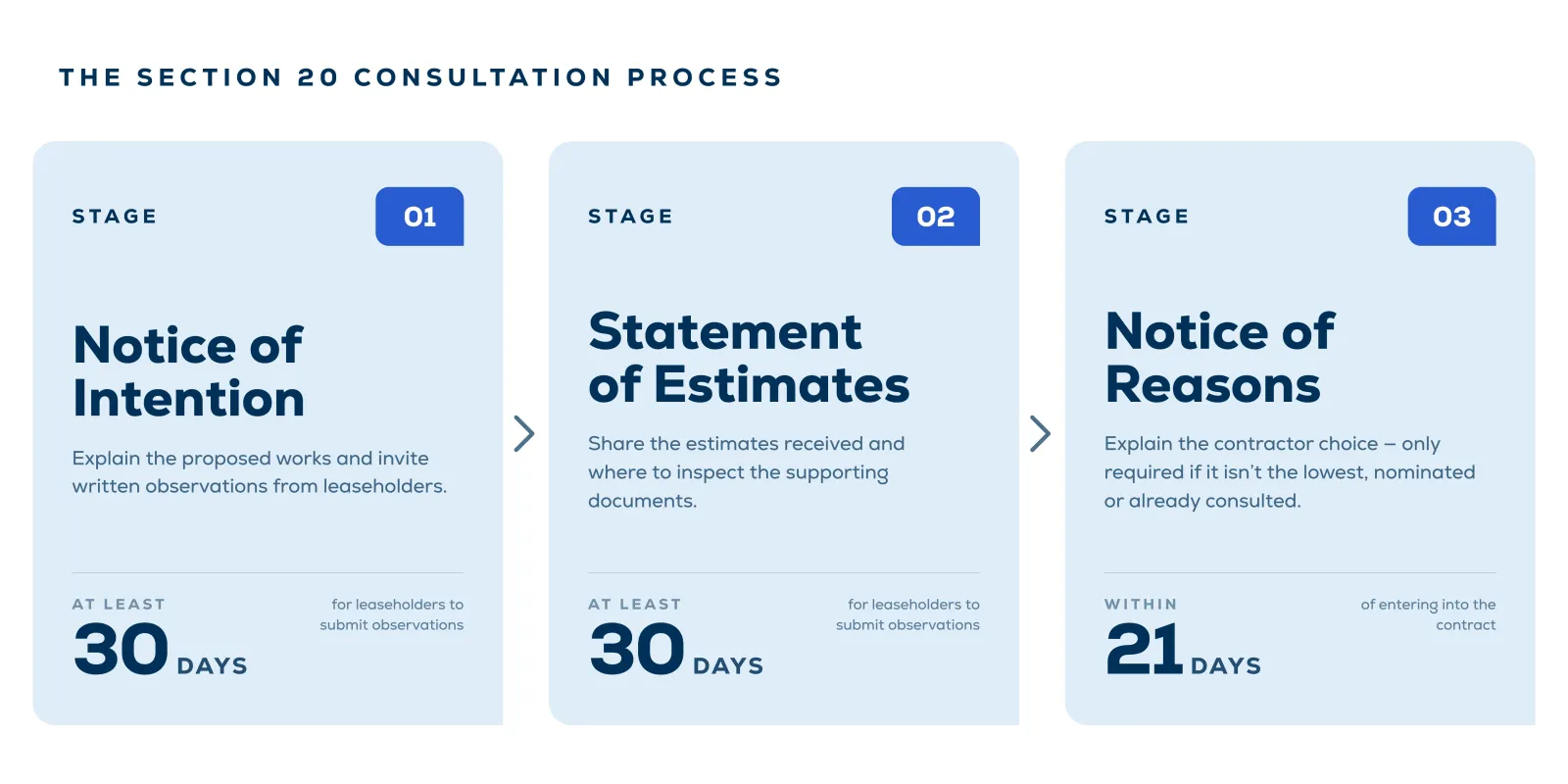
Stage 1: Notice of Intention
The process usually begins with a Notice of Intention – this is what is commonly described as a “Section 20 notice”.
The notice explains the proposed works or services and formally notifies leaseholders that the consultation process is beginning. At this stage, the scope of the works may still be relatively broad, particularly on larger projects where surveys or specifications are still being developed.
The notice must also invite leaseholders to provide written observations within the consultation period, which is usually at least 30 days.
For qualifying works, leaseholders may also nominate contractors that they would like the landlord or managing agent to obtain estimates from during the tendering process.
Stage 2: Statement of Estimates
Once estimates have been obtained, leaseholders must usually be provided with a Statement of Estimates.
This stage summarises the estimates received for the proposed works and explains where and how leaseholders can inspect the estimates and supporting documentation.
Leaseholders must again be given the opportunity to submit written observations during the consultation period. Landlords or managing agents are expected to consider these observations before proceeding further.
Where a nominated contractor has submitted a compliant estimate, this must generally be included within the consultation process alongside other tenders.
Stage 3: Notice of Reasons
A final notice may then be required if the chosen contractor is not:
-
the lowest estimate
-
a contractor nominated by leaseholders
-
or a contractor connected to a long-term agreement already consulted on
This notice is commonly referred to as a Notice of Reasons.
It explains why a particular contractor has been selected and must normally be issued within 21 days of entering into the contract.
Not every Section 20 consultation will require this third stage. However, where it does apply, failing to issue the notice correctly can create difficulties when recovering costs through the service charge.
How Long Does Section 20 Consultation Take?
For standard qualifying works, the formal consultation process will usually take at least two to three months and often longer in practice.
This is because leaseholders are normally given two separate consultation periods:
-
30 days to respond to the Notice of Intention
-
30 days to respond to the Statement of Estimates
In some cases, a further Notice of Reasons may also be required after the contract has been awarded. This does not create another full 30-day consultation period, but it can still add time to the overall process.
That said, the statutory periods are only part of the timeline. In practice, the process will likely take longer once the wider project work is factored in, including:
-
Preparing the scope of works
-
Carrying out surveys or inspections
-
Obtaining contractor estimates
-
Reviewing leaseholder observations
-
Responding to questions or objections
-
Finalising procurement and contract arrangements
Larger or more technically complex projects can therefore take considerably longer than the minimum consultation periods suggest.
For managing agents and property managers, the safest approach is to build Section 20 consultation into the project programme from the beginning. A rushed consultation can create avoidable delays, especially if notices need to be corrected or leaseholders raise valid concerns about the proposed works.
What Happens if Section 20 Consultation Is Not Followed?
Failing to follow the Section 20 consultation requirements can have serious financial consequences.
In most cases, if the correct consultation procedure is not followed, the amount recoverable from each leaseholder becomes capped at:
-
£250 for qualifying works
-
£100 per year for qualifying long-term agreements
This applies regardless of the actual cost of the works, even where the works themselves were necessary or the costs were otherwise reasonable.
For larger major works projects, capped contributions can leave building owners or management companies responsible for a substantial shortfall that may not be recoverable through the service charge.
Leaseholders may also challenge the recoverability of costs through the First-tier Tribunal (Property Chamber), particularly where they believe consultation requirements were not followed correctly or the process was procedurally unfair.
However, failure to complete the consultation process does not always prevent costs from being recovered in full. Under Section 20ZA of the Landlord and Tenant Act 1985, an application can be made to the Tribunal for dispensation from the consultation requirements. This is most commonly used where:
-
Urgent works are required
-
Emergency repairs are needed
-
There are health and safety concerns
-
Full consultation was not reasonably practical
The Tribunal will usually consider whether leaseholders suffered any real prejudice as a result of the consultation failures, rather than treating every procedural defect as automatically fatal to cost recovery.
Even so, dispensation applications can create additional cost, delay and uncertainty. In practice, it’s usually far safer to ensure the consultation process is handled correctly from the outset and that clear records are maintained throughout the project.
Can Leaseholders Refuse to Pay for Major Works?
Leaseholders may challenge major works costs in certain circumstances, particularly where they believe the costs are unreasonable or the Section 20 consultation process was not followed correctly.
Under the Landlord and Tenant Act 1985, service charges are generally only recoverable where:
-
The costs are reasonably incurred
-
The works are carried out to a reasonable standard
-
The correct consultation requirements have been followed
As a result, disputes commonly arise where leaseholders believe:
-
The proposed works are unnecessary
-
The costs are excessive
-
The scope of works has not been properly explained
-
Contractor selection was unreasonable
-
The consultation process was handled incorrectly
Leaseholders may apply to the First-tier Tribunal (Property Chamber) to challenge the recoverability or reasonableness of the costs before or after payment is demanded.
However, challenges do not necessarily prevent works from proceeding. In many cases, disputes arise because leaseholders feel they have not been properly informed about why the works are necessary, how contractors were selected or how costs have been calculated.
For that reason, clear communication is one of the most important parts of successful Section 20 consultation. Leaseholders are more likely to engage constructively where the scope of works, procurement process and long-term benefits of the project have been explained clearly from the outset.
Best Practices for Managing Section 20 Major Works
A successful Section 20 process is about more than issuing the right notices. It also depends on broader planning, clear communication and a well-managed procurement process.
Major works affect people’s homes, finances and day-to-day routines, so even technically compliant consultations can become difficult if leaseholders feel poorly informed or excluded. It’s a good idea to consider early resident engagement, meetings, panels and communication before, during and after the formal Section 20 process.
With that in mind, the following ideas can help reduce disputes and support smoother project delivery.
Start with a Clear Scope of Works
A vague or incomplete scope is one of the easiest ways to create confusion.
Before notices are issued, the proposed works should be properly assessed and clearly described. This may involve condition surveys, specialist inspections, photographs, access reviews and input from surveyors or technical consultants.
The clearer the scope, the easier it is for leaseholders to understand why the works are needed and for contractors to provide meaningful estimates against a schedule or works.
Explain Why the Works Are Necessary
Leaseholders are more likely to object where they cannot see why works are required, especially if costs are high.
Rather than simply listing the proposed works, it is usually helpful to explain the underlying problem. For example, roof repairs may be needed because of recurring water ingress, external redecoration may protect ageing timber, or render repairs may be required to prevent further deterioration.
This does not need to be overcomplicated. A clear explanation of the issue, the risks of delaying work and the expected benefit of the project can make consultation much more constructive.
Keep Accurate Records Throughout
Record-keeping is essential. You should retain copies of notices, estimates, observations, responses, contractor nominations, inspection reports and decisions made during procurement.
This is especially important if the process is later challenged. As we’ve covered, failure to follow the procedure can limit recovery to £250 per leaseholder for qualifying works, regardless of the final bill, so documentation is critical to protect the recoverability of costs.
Take Leaseholder Observations Seriously
Leaseholder comments should not be treated as a box-ticking exercise.
Observations may raise practical issues that affect project delivery, such as access problems, historic defects, previous failed repairs, vulnerable residents or concerns about disruption. In some cases, they may also identify useful contractors or highlight gaps in the proposed scope.
The consultation regulations require observations to be considered, and poor handling of comments is a common source of mistrust.
Avoid Rushing Procurement
A rushed tender process can undermine the quality of the consultation.
Contractors need enough information to price the works properly, and leaseholders need enough detail to understand how estimates compare. Where bids are difficult to compare, or where the cheapest option is not selected, the reasoning should be carefully recorded and clearly explained.
This is particularly important on technically complex works where the lowest estimate may not represent the best long-term value.
Plan Around Occupied Buildings
Major works are rarely carried out in ideal conditions. Residents may be living in the building throughout the project, and disruption can quickly become a source of frustration.
Good planning will consider access, noise, working hours, resident communications, vulnerable occupants, health and safety arrangements and how complaints will be handled once work begins.
For external works, access strategy is particularly important. Scaffolding, rope access, mobile platforms or hybrid systems can all affect cost, duration and disruption, so the access method should be considered early rather than treated as an afterthought.
Do Not Assume Agreement Replaces Consultation
Even where residents appear supportive, the formal consultation process should still be followed where the thresholds are met.
For example, RMCs and RTM companies should not assume that unanimous agreement at a residents’ meeting removes the need for Section 20 consultation. Even where residents broadly support the proposed works, the statutory consultation requirements still apply.
Build in Time for Questions and Clarification
Many disputes arise because questions are answered too late, too briefly or not at all.
A more considered approach – beyond the statutory requirements – can help. This might include a resident meeting, written FAQs, clear points of contact or a project update after observations have been reviewed.
The aim is not to remove every objection, which may not be possible. The aim is to show that the process is transparent, that concerns have been considered and that decisions have been made for sound reasons.
Planning Major Works? We Can Help Minimise Disruption
Section 20 consultation is easier to manage when the works themselves are clearly scoped, carefully planned and delivered with minimal disruption to residents.
At Spectrum, we support property managers, surveyors, managing agents and housing providers with high-quality external major works, including external redecoration, render repairs, roof repairs, facade restoration, timber repairs and much more.
Our approach is built around efficient access. By using rope access, MEWPs, patented modular pole systems and other scaffold-free methods where appropriate, we can reduce costs, shorten project timelines and limit disruption for residents, visitors and building users.
Just as importantly, our work is carefully surveyed, specified and fully documented from the outset. That means clearer scopes, more transparent project planning and better communication throughout the works.
Whether you’re preparing for Section 20 consultation or already planning a major external refurbishment, our team can help you deliver the project safely, efficiently and to a high standard.
Get in touch with our team today or learn more about our major works services here.
Your Building Deserves Thoughtful, Expert Care
Ensure your building remains in top condition with Spectrum Specialist Support. Our expert team offers a full range of exterior maintenance services, from external cleaning and repairs to comprehensive restoration of brick, render, stone and other substrates.
With an IRATA-certified team of abseilers and experience across hundreds of varied projects, we’ll find an access solution that saves you time and money, even on the most complex elevations.
Whether you need emergency maintenance or a tailored service plan, we are here to help. Contact us directly on 020 3551 6206 or email us at info@spectrumss.co.uk to discuss your requirements and receive a free consultation and quote.